
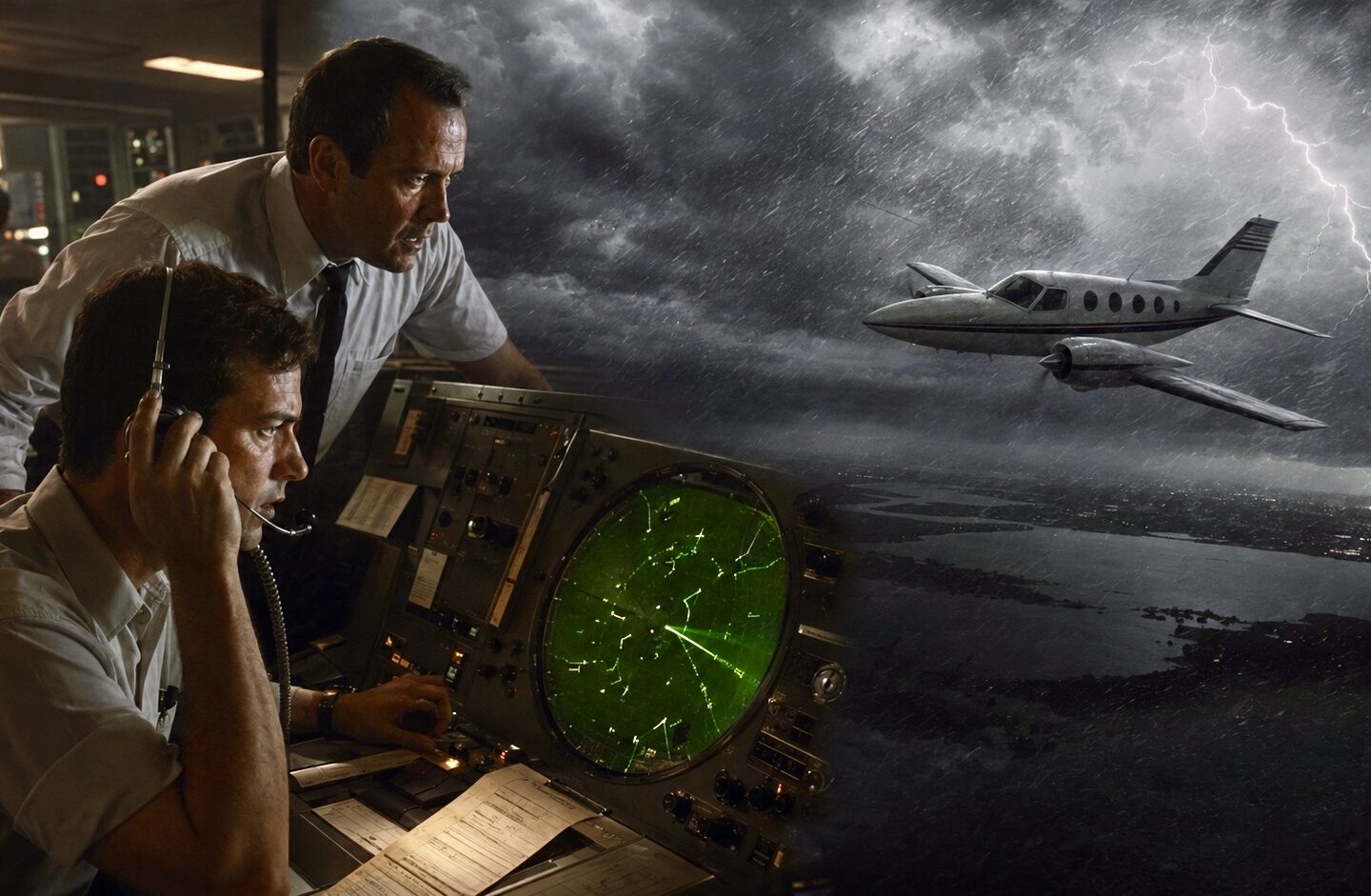
I spent 37 years as an air traffic controller, and during that time I handled more emergencies than I can count.
Some were serious.
Some were strange.
A few stayed with me for the rest of my life.
This was one of them.
This is a 9-minute video overview:
It happened around 1969 or 1970, before we had ARTS automatic radar tracking and before Mode C altitude information was something we could depend on.
I was working at New Orleans Approach Control at Moisant Airport, now Louis Armstrong New Orleans International Airport.
The night before this incident, I had worked an evening shift.
The weather was IFR from Houston all the way east toward Gulfport, Mississippi. In New Orleans, the ceiling was about 700 feet overcast with roughly two miles visibility.
A pilot in a Piper Cherokee called and said he needed help getting through the clouds.
I identified him about 20 miles southwest of Moisant.
I asked how much fuel he had.
“Less than 30 minutes.”
I asked how many people were aboard.
His wife and his 10-year-old daughter.
Then I learned something else.
He was not instrument rated.
At that point, I didn’t need the pilot to use the word emergency.
As far as I was concerned, a non-instrument-rated (not rated to fly into clouds) pilot on top of an overcast at night, with his wife and young daughter aboard and less than 30 minutes of fuel, was already in an emergency.
I did not announce that over the frequency.
The pilot already had enough to deal with.
I didn’t want to add an emotionally upset wife and possibly a frightened or screaming 10-year-old to the cockpit.
Back then, when the wind was out of the north, we regularly ran radar surveillance approaches to Runway 1.
So that is what I did.
I talked him down through the clouds.
He broke out at about 700 feet and landed.
It was almost a non-event.
I went home.
The next afternoon I came back to work at two o’clock.
My supervisor met me and said, “We need to talk.”
We went into an office.
He closed the door, pulled out a folder, and slid a letter across the desk.
It was a formal letter of reprimand.
I was being reprimanded because I had not gone through all the legal language procedures in the Air Traffic Control Manual concerning information to be requested from pilots entering or about to enter IFR (clouds) conditions.
The letter basically said:
Never let this happen again.
I was dumbfounded.
Then I got angry.
I asked my supervisor, “Who in the hell thought of this?”
He told me he had not wanted to write it.
The facility manager had ordered him to.
I tore the letter up right there in front of him.
He told me to calm down.
Eventually I did.
But I had lost whatever respect I had for that facility manager.
A few minutes later, my supervisor and I walked into the radar room.
There was a large thunderstorm over Lake Pontchartrain.
My supervisor told me to take the Departure North position.
I relieved the controller.
I noticed a westbound radar target about 20 miles north of Moisant.
It was heading directly toward the thunderstorm.
The airplane was a Cessna 402.
The aircraft entered the thunderstorm at about 10,500 feet.
A few moments later, 121.5 — the emergency frequency – came alive.
The pilot was screaming.
“Help! Help! Help!”
“I’ve lost control of the airplane!”
“We’re going to crash!”
He reported being somewhere around 8,000 feet.
For a second, I remember thinking:
This cannot be real.
Everybody in the radar room suddenly knew something terrible was happening.
Co-workers were shouting.
My supervisor was standing directly behind me yelling:
“Do something, Clint! Do something!”
I had no Mode C altitude readout.
We had no ARTS automatic tracking.
All I had was a raw radar target that appeared once every sweep of the antenna and less than 400 hours of flight time as a private pilot!
I did not know what attitude the aircraft was in.
I did not know how fast it was descending.
I did not know whether the wings were level.
I did not know whether the airplane was about to break apart.
I knew only one thing.
The pilot had lost control.
I keyed 121.5 emergency frequency.
“Come off the power. Take your hands off the yoke. Just let the airplane fly. It will fly itself.”
Then I waited.
That may have been the longest minute of my career.
I watched the radar scope.
Every sweep of the antenna I waited for that target to reappear.
I fully expected that on one of those sweeps it simply would not be there.
There was nothing else I could do.
The aircraft had entered the thunderstorm at about 10,500 feet.
The pilot reported being out of control around 8,000 feet.
Eventually his voice came back over the frequency.
This time he was calm.
“I’m at 3,000 feet. Level. Everything’s okay.”
The airplane had lost roughly 7,500 feet from thunderstorm entry to recovery.
Then we learned there were four passengers in the back.
Five people total.
I gave the pilot radar vectors back to Moisant.
He successfully landed on Runway 10.
Afterward, medical personnel examined everyone aboard.
The pilot and all four passengers had bruises.
That was it.
Five people had gone through an uncontrolled descent inside a thunderstorm and walked away with bruises.
My supervisor immediately had me relieved from the radar position.
We went back into the same office where, only minutes earlier, I had been handed the reprimand.
He closed the door.
Then he asked:
“Clint, did you have this pilot declare an emergency?”
I looked at him and said:
“Are you fucking kidding me?”
He said:
“No. You know what I have to deal with.”
I did.
He was talking about the facility manager.
Then my supervisor said, “Follow me.”
We went down to the equipment room.
He backed up the recording tape to before the incident and ran the tape through so the recording would no longer be available.
He later spoke directly with the pilot.
The airplane was a Cessna 402.
It had departed Mobile, Alabama, and was on a charter flight to Lake Charles, Louisiana.
The pilot held a commercial pilot certificate. He did not have an instrument rating, which under the rules governing that operation at the time apparently was not required.
He never entered the incident into the facility logbook.
As far as I know, the facility manager never knew it happened.
Six months later, that supervisor transferred out of New Orleans on a promotion somewhere in the Southwest Region and I transferred to DFW.
I have thought about him many times over the years.
He had been ordered to reprimand me for using my judgment to save a pilot, his wife, and his 10-year-old daughter the night before.
Then, within minutes of handing me that reprimand, he stood behind me while another airplane with five people aboard was falling out of control through a thunderstorm.
And after it was over, he protected me from the same bureaucracy that had just punished me.
After all these years, I have to say:
He was a good guy.
I didn’t think much about this incident for decades.
Then a few years ago, the memory came back vividly when I started a book on my air traffic control experiences.
I began having difficulty sleeping.
Not long afterward, I developed shingles for the first time in my life.
I cannot prove that remembering the incident caused either one, but I decided to end writing an autobiography.
But I have spent more than 40 years working with emotional memory, trauma, and the ways the nervous system can react to events long after they are over.
The thinking brain may know:
That happened more than 50 years ago.
The nervous system does not always care.
Sometimes an old event becomes emotionally present again.
And when I think back to sitting in front of that radar scope, staring at that little target and wondering whether five people were about to disappear forever, I can still understand why.
That was one of the most frightening moments of my life as an air traffic controller.