

This is an one minute Video Overview:
Sometimes an emotional reaction appears before you understand what caused it.
Your chest tightens. Your stomach sinks. Your breathing changes. You suddenly feel anxious, ashamed, angry, helpless, or threatened—even though the present situation does not seem to justify the intensity of the reaction.
The conscious mind may not know why the feeling is there, but the body is responding as though something important is happening.
Speed Trace is a brief process for following that emotional reaction backward through time. You stay connected to the feeling, check whether it was present at earlier ages, and continue backward until you reach a time before the emotional pattern existed.
You do not have to explain the feeling, analyze your childhood, or recover a specific memory.
The Origins of Speed Trace
Speed Trace was developed by Doyle Henderson, an aeronautical engineer, and Bobby Matherne, a physicist/humanist.
During the 1980s, Henderson sold this procedure to the public on a floppy disk. Around 2009, Matherne persuaded him to make it available free to the public on Matherne’s website. Both men have since died.
The procedure is remarkably simple. Its power is not in intellectual analysis. It comes from maintaining contact with the emotional or physical response while moving backward through time.
I use Speed Trace as a memory reconsolidation process. The old emotional learning is activated, traced to an earlier period, and experienced from a point before the pattern had been learned.
The basic question is:
“I am __ years old. Do I have the feeling? Yes or no?”
You fill in the age, say the entire question aloud, and answer aloud.
Then you continue moving backward.
Step 1: Choose the Feeling
Choose one unwanted emotional reaction or body sensation.
It might be:
- Anxiety
- Fear
- Shame
- Anger
- Grief
- Helplessness
- Pressure
- Loneliness
- Self-judgment
- Tightness or heaviness somewhere in the body
Notice where you experience it physically.
You might feel pressure in your chest, a knot in your stomach, tension in your throat, heat in your face, heaviness in your shoulders, or an empty feeling inside.
Rate the intensity from 1 to 10.
You do not need to know what caused it. You only need to recognize the feeling you want to trace.

Step 2: Stay With the Sensation
Allow yourself to notice the sensation without trying to change it.
Pay attention to its location and qualities:
- Does it have a shape?
- Is it heavy or light?
- Is it warm or cold?
- Is it moving or still?
- Does it feel tight, hollow, sharp, soft, or numb?
Do not search for an explanation or force yourself to remember anything.
The purpose is not to make the feeling stronger. You are simply maintaining enough contact with it to know:
“This is the feeling I am tracing.”
Your eyes may remain open or closed.

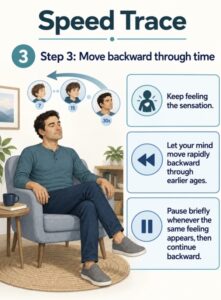
Step 3: Move Backward Through Time
Begin with your present age.
Say aloud:
“I am [your present age]. Do I have the feeling? Yes or no?”
Answer aloud with the first response that comes to you.
Then move backward through earlier ages. For example, a 50-year-old might say:
- “I am 50. Do I have the feeling? Yes or no?”
- “I am 40. Do I have the feeling? Yes or no?”
- “I am 30. Do I have the feeling? Yes or no?”
- “I am 20. Do I have the feeling? Yes or no?”
- “I am 15. Do I have the feeling? Yes or no?”
- “I am 10. Do I have the feeling? Yes or no?”
Continue whether the answer is yes or no.
Do not stop to analyze an answer. Do not try to figure out what happened at a particular age. Briefly notice the response and keep moving.
When you reach age 10, begin moving backward one year at a time:
- Age 9
- Age 8
- Age 7
- Age 6
- Age 5
- Age 4
- Age 3
- Age 2
- Age 1
Keep the process moving at a steady pace.
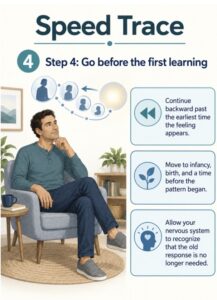
Step 4: Go Back Before the Pattern Began
Continue beyond the earliest age at which the feeling appears.
Move backward through infancy, birth, and then to a point before birth or before the emotional pattern began.
You might say:
- “I am 6 months old. Do I have the feeling? Yes or no?”
- “I am newly born. Do I have the feeling? Yes or no?”
- “I am before birth. Do I have the feeling? Yes or no?”
Do not invent a memory or force an answer.
A simple felt sense of yes or no is enough.
The process is complete when you have reached a point before the old emotional response was present.
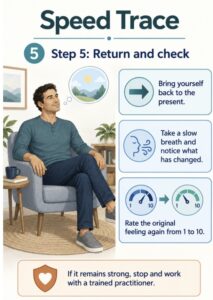
Step 5: Return to the Present and Check
Bring your attention back to the present.
Open your eyes if they were closed. Take a slow breath and notice your body, your breathing, and the room around you.
Now think about the original issue again.
Rate the emotional or physical response from 1 to 10.
What changed?
The feeling may be:
- Weaker
- Completely absent
- Located somewhere else
- Less important
- Difficult to recreate
- Present but noticeably different
Do not demand a particular result. Simply notice what is different.
If the feeling remains strong, do not push harder. Stop and consider working with a trained practitioner.
The Complete Speed Trace
The entire process can be summarized in five steps:
- Choose one unwanted feeling. Notice where it is in your body and rate its intensity from 1 to 10.
- Stay connected to the sensation. Feel it without explaining it or searching for a cause.
- Move backward through earlier ages. At every age, ask aloud: “I am __ years old. Do I have the feeling? Yes or no?”
- Continue to a time before the pattern existed. Move through infancy, birth, and before birth or before the first emotional learning.
- Return to the present and check. Bring the original issue to mind and rate the feeling again.
The essential rule is simple:
Stay with the feeling, say each age check aloud, answer yes or no, and continue backward without analyzing why.
An Important Safety Note
Speed Trace is not a substitute for appropriate medical or mental-health treatment.
Stop if you become overwhelmed, disoriented, detached from reality, or afraid that you may lose control.
People dealing with severe trauma, dissociation, active self-harm, psychosis, or intense panic should use this process only with an appropriately trained professional.
Clint77090@Gmail.Com