
This is a 7 – minute video overview:
There is an interesting relationship between two experiences that seem almost too simple to matter:
Peace.
Now.
The more I think about them, the more I wonder whether they are really describing almost the same psychological place.
Especially when we are connecting with another human being. We humans are like all mammals in that we are connected to our mother’s umbilical cord- the only exception is that platypuses hatch from an egg.
Peace Is Usually in the Now
Think about a moment when you felt completely at peace with another person.
Maybe you were sitting quietly with someone you love.
Maybe you were holding a child or grandchild.
Maybe you were talking with a close friend and suddenly realized neither of you was trying to accomplish anything.
You were simply there together.
In those moments, there may be very little past.
There may be very little future.
There is just:
You.
The other person.
And this moment.
That is Now.
And very often, that is also Peace.
What Takes Us Out of the Now?
The human brain is a prediction machine.
It doesn’t simply experience what is happening. It continuously uses previous learning to anticipate what something means and what might happen next.
That ability is enormously useful.
But it can also interfere with human connection.
When I meet another person, I may not simply experience who that person is right now.
My brain may be asking:
Can I trust you?
Do you like me?
Am I safe with you?
What do you think of me?
Am I good enough?
What do I need to do?
What might go wrong?
Suddenly there are three people in the room:
Me.
You.
And my predictions about you.
And sometimes the predictions become more important than the person.
Peace Requires Less Prediction
This may help explain why peace and being present are so closely related.
When we are deeply present with another being, we temporarily stop demanding that the moment become something else.
We aren’t trying to fix it.
We aren’t comparing it with yesterday.
We aren’t rehearsing tomorrow.
We aren’t constantly evaluating ourselves.
We aren’t trying to determine what the other person thinks of us.
For a moment, the predictive machinery becomes quieter.
We simply experience the person who is actually in front of us.
That is connection.
Another Being Doesn’t Have to Be Human
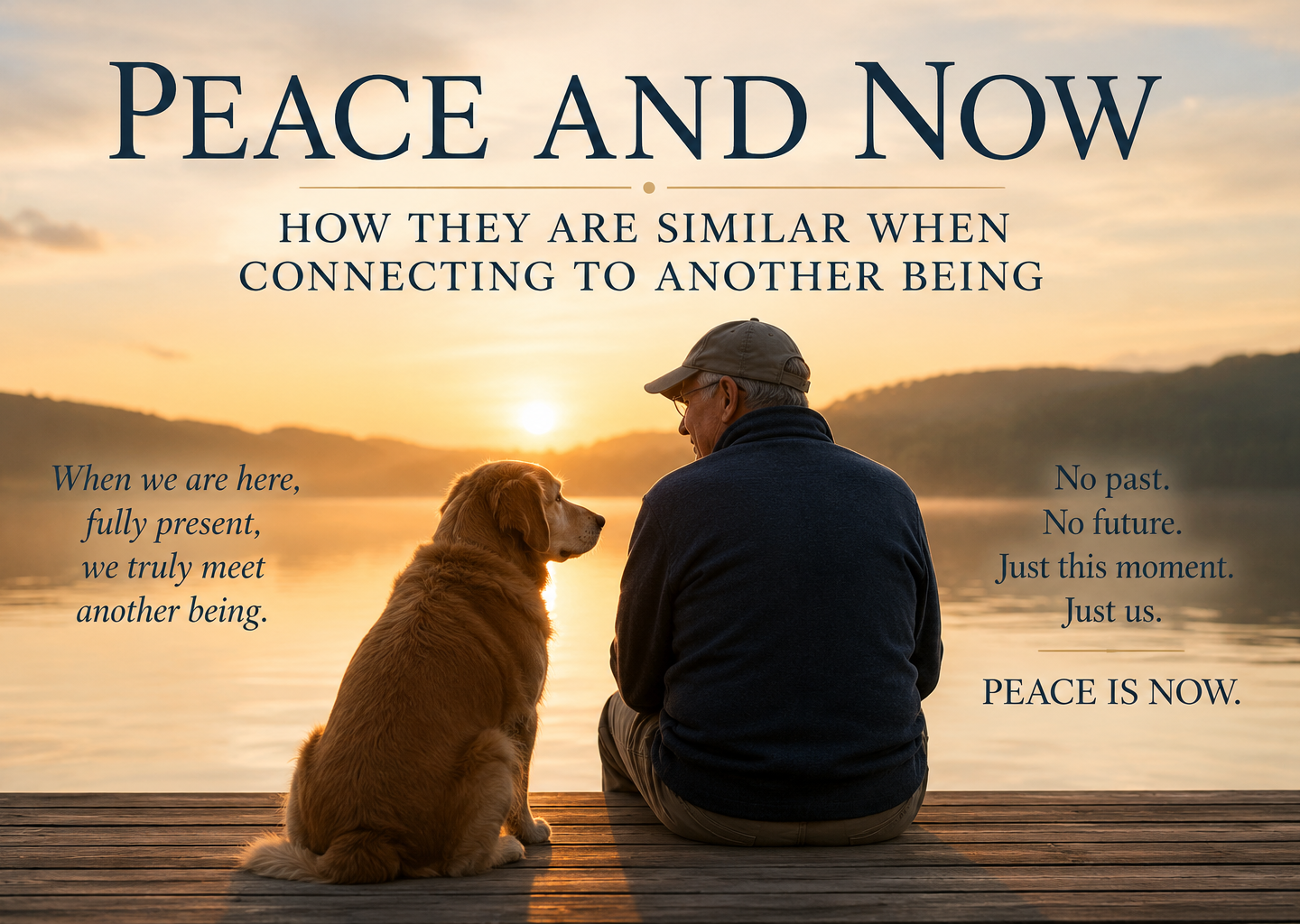
You can see this very clearly with animals.
Sit quietly with a dog.
The dog doesn’t care about your résumé.
It doesn’t care what you accomplished ten years ago.
It isn’t particularly interested in what you intend to accomplish next Tuesday.
The relationship exists almost entirely in the present.
You touch the dog.
The dog looks at you.
You are together.
Now.
And there can be enormous peace in that simple interaction.
Perhaps animals sometimes make connection easier precisely because they don’t activate as many of our complicated human predictions.
Children Know This Too
Young children can also pull us into the Now.
A child doesn’t experience a sunset by thinking:
“I wonder whether tomorrow’s sunset will be better.”
The child sees the colors.
The clouds.
The light.
This one.
Right now.
Adults often have to relearn something children seem to understand naturally:
Life is only experienced in the present.
Everything else is memory or prediction.
Maybe Connection Happens When the Distance Disappears
When two people are genuinely present with each other, something unusual happens.
For a moment, there is less interpretation.
Less defense.
Less anticipation.
Less judgment.
Less autobiography.
There is simply awareness of another living being.
I see you.
You see me.
Neither of us needs this moment to be different.
That may be one of the purest forms of human connection.
And perhaps this is why Peace and Now feel so similar.
Peace isn’t necessarily the absence of noise, problems, sadness, or uncertainty.
Peace may be what naturally appears when we stop mentally leaving the moment we are actually living.
The Surprise Is Being Here
Most of our lives are spent moving toward something.
Waiting for something.
Remembering something.
Preventing something.
Trying to make something better.
But occasionally we stop.
We look at another person.
Or a child.
Or an animal.
Or even a sunset.
And for a few seconds there is nothing to solve.
Nothing to become.
Nothing to prepare for.
There is only this extraordinary fact:
We are here.
Together.
Now.
And maybe that is Peace.

More on Peace: