
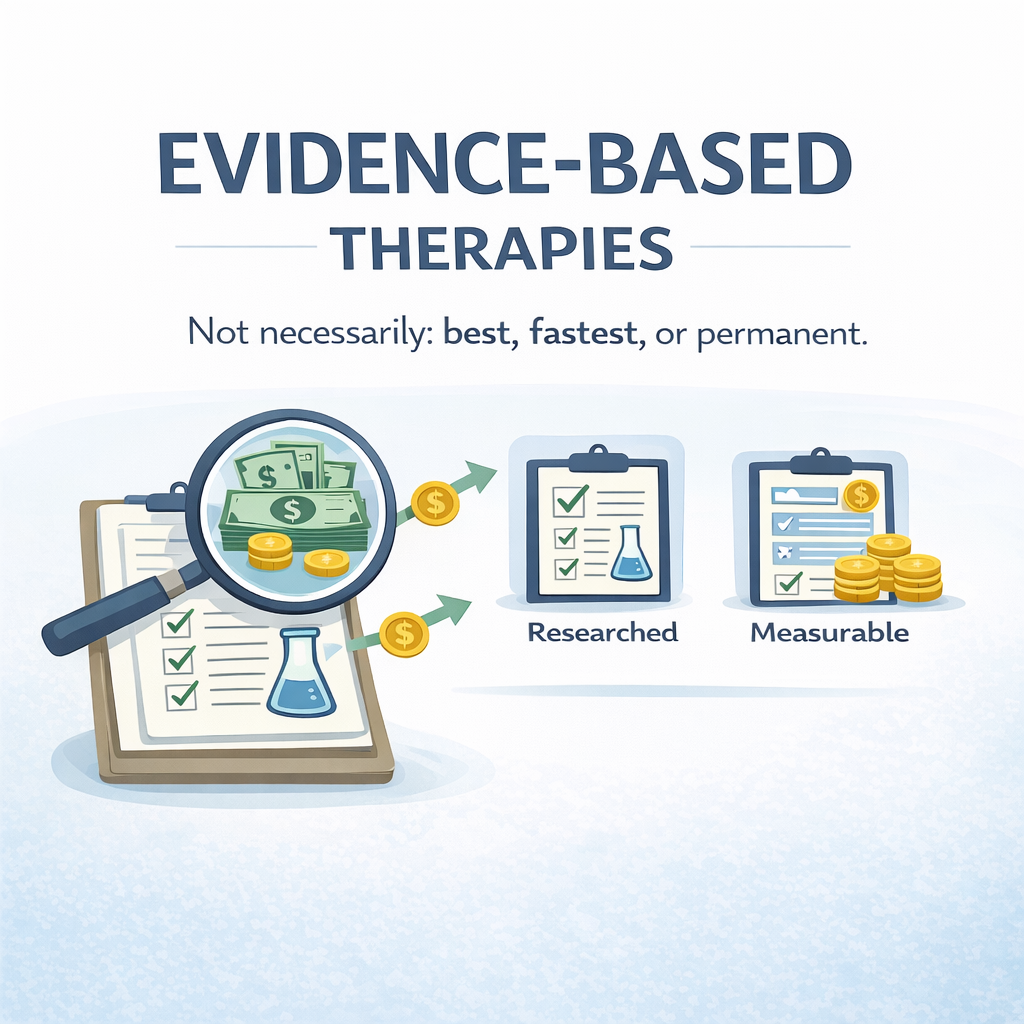
When people hear “evidence‑based therapy,” they assume it means:
“This is the treatment proven to work best.”
But more often, it means:
“This is the treatment someone could afford to study.”
This is a 15 – minute “Deep Dive” audio:
This is a 6 – minute video overview on this post:
I lived with PTSD flashbacks for more than 12 years. I was successfully treated in a single session over 42 – years ago – yet that therapy modality is still not considered “evidence‑based.” No one has funded a study on this very effective treatment for flashbacks or intrusive memories!
See:https://clintmatheny.com/how-i-healed-my-ptsd/
Research Runs on Funding – Not Just Truth
Therapy research is largely funded by:
• Big Pharma
• Government agencies like the NIH
• Universities operating inside grant‑driven systems
These systems reward treatments that are:
• manualized
• standardized
• measurable with symptom checklists
• deliverable in short, structured formats
Numerous studies show CBT produces modest, often temporary effects for trauma and clinical depression – especially when compared to experiential approaches that update emotional learning.
Evidence Is Expensive – Typical Cost
These figures reflect standard NIH and academic trial budgets:
Pilot study $50k–$250k
Standard RCT $500k–$2M
Large multi‑site RCT $3M–$10M+
Therapies can’t be patented.
There’s no billion‑dollar sponsor waiting for ROI.
So the therapies with the biggest “evidence base” are usually the ones easiest to fund – not necessarily the ones that create the deepest, most lasting change.
The Pharma Incentive Reality
It’s not that pharmaceutical companies want therapy to fail.
It’s that their business model depends on ongoing medication use.
There is no financial incentive to fund therapies that might:
• permanently resolve conditions
• reduce long‑term medication reliance
• shrink the medication market
So pharma‑backed research naturally gravitates toward:
• medication
• medication + therapy
• adherence
• symptom management
Drug companies don’t need therapy to fail – they just have no business reason to fund therapies that make their products less necessary.
That’s economics, not conspiracy.
What Happens to Therapies That Do Update Emotional Learning?
Memory reconsolidation–based approaches don’t vanish – but they rarely become institutional standards quickly.
They tend to:
Live on the edges
Used by specialist clinicians, spreading through training networks and word of mouth.
Get labeled “promising”
Not because they lack results, but because they lack multi‑million‑dollar trials.
Be practitioner‑dependent
They require timing, attunement, and flexibility – which makes them harder to standardize.
Spread through outcomes, not advertising
Clinicians keep using what works. Clients refer others.
Get absorbed under new labels
The mechanism enters mainstream language long before the original models get recognition.
Wait for science to catch up
Mechanism research grows first. Institutional acceptance often takes decades.
What Gets Left Out
Deep experiential work, identity‑level change, and emotional learning updates are:
• harder to standardize
• harder to measure with checklists
• harder to package into short protocols
So they’re studied less — and look weaker “on paper,” even when they’re powerful in practice.
Bottom Line
When you hear:
“There isn’t enough evidence.”
It often means:
“No one had millions to study it in the approved format.”
So remember:
Evidence follows funding.
Funding follows scalability.
Healing follows emotional learning.
Post on Memory Reconsolidation:
https://clintmatheny.com/rtm-1/
Recommendations
The National Institutes of Health shall designate all therapies that operate through the mechanism of emotional memory reconsolidation as evidence‑based therapies (MR). CMS shall require Medicare, Medicaid, and all federally regulated health insurance plans to provide full coverage for these MR‑designated therapies.All qualifying therapeutic modalities shall include the suffix “(MR)” to clearly identify their mechanism of action and distinguish them from symptom‑management – only treatments.
Examples of “Memory Reconsolidation” Based Therapies (These differ in form, style, and branding – but they converge on the same underlying mechanism):
- Trauma/Phobia Cure (RTM)
- The Haven Technique
- Dynamic Spin Procedure
- The In Technique
- Eye Movement Integration (EMI)
- FreeSpotting
- BrainSpotting
- Clean Language Therapy (my favorite)
- EMDR
- The Flash Technique
- Coherence Therapy
- Progressive counting
- (If your favorite isn’t listed – no worries. If it works via reconsolidation, it belongs.
https://clintmatheny.com/opinion-the-best-ptsd-treatment-youve-never-heard-of/
Clint77090@Gmail.Com