

This is a 4-minute Google video overview:
From Imperative Self Analysis to the Emotional Autopilot Reset:
I am approaching 81 years of age and have practiced psychotherapy for over 41 years. Like many therapists, I have had favorite modalities. Mine have been Clean Language (what-is-clean-language-therapy/) and the Imperative Self model (using-imperative-self-analysis/)
The Imperative Self model, developed by Leslie Cameron-Bandler and her colleagues in the late 1980s, remains one of the most powerful systems I have ever used for understanding how personality organizes itself around unconscious emotional learning. For decades, I used the full Imperative Self elicitation process to map the emotional architecture beneath people’s lives.
Then I had a sobering thought.
Fewer than 400 therapists were ever trained in the model, and only a small number still actively use it. If that trend continues, much of the model may eventually disappear. That realization forced me to ask a simple question:
What is the smallest piece of the model that creates the biggest change?
The answer surprised me.
Over time, I began focusing less on the entire Imperative Self structure and more on a single element: the client’s Virtual Question or Virtual Statement—the unconscious question or command that quietly organizes their emotional life. Examples include:
- Am I safe?
- What did I do wrong?
- Am I enough?
- Don’t make a mistake.
- Be careful.
These hidden rules often organize a person’s recurring emotional states, behaviors, and identity.
What I began noticing was this:
When the Virtual Question or Virtual Statement genuinely collapses, the rest of the personality structure often begins reorganizing on its own.
The filter changes.
The obsessions lose their urgency.
The emotional menu shifts.
The person stops asking the question that has been running their life.
This led me to a startling conclusion:
We may not need the full Imperative Self elicitation to create personality-level change.
Instead of spending hours mapping the entire system, it may be possible to identify the organizing Virtual Question or Virtual Statement and apply a memory reconsolidation intervention directly to that core emotional prediction. When the prediction changes, the personality built around it often changes as well.
I call this approach:
The Emotional Autopilot Reset
The Reset is not about managing symptoms, improving coping skills, or endlessly analyzing the past.
It is about identifying the unconscious question that has organized a person’s emotional life and updating the emotional learning that made that question necessary in the first place – sometimes in just a session!
After more than four decades in psychotherapy, I never expected one of my biggest discoveries to be a simplification.
Yet that is exactly where the evidence has led me.
Sometimes the fastest way to change a personality is not to map the entire system.
Sometimes it is enough to find the question that built it, because it determines:
• How safe you feel
• How confident you feel
• How you handle conflict
• How you interpret rejection
• How much pressure you experience
• How you make decisions
• How you relate to others
Most importantly, it organizes your emotional life.
The Virtual Question Versus Virtual Statement
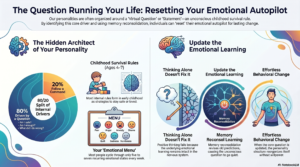
For roughly 80% of people the driver appears as a question:
• Am I enough?
• What did I do wrong?
• Will I get this right?
• Am I safe?
• Do they like me?
• What should I be doing?
For others it centers on belonging:
• How do I stop being rejected?
• How can I escape my loneliness?
For about 20% the driver is a statement:
• Don’t make a mistake.
• Be careful.
• Get it right.
• Never let your guard down.
• Stay in control.
Whether question or statement, the function is the same. It is an old emotional rule that never shuts off.
Your Emotional Menu
Every emotional pattern has an organizer. The Virtual Question is often that organizer. Most people live inside a surprisingly small emotional menu of five to seven recurring emotional states, for example:
• Anxiety; Pressure; Fear; Urgency; Loneliness; Frustration; Shame; Resignation; Emptiness; Vigilance; Sadness
These emotions are not random. They hang together, reinforce one another, and are usually organized around the same underlying Virtual Question. Your emotional menu is not your personality. It is the emotional footprint of the rule running your life. This explains why the same emotions keep showing up decade after decade even when circumstances change.
Origins and Why Thinking Alone Doesn’t Fix It
Most Virtual Questions and Statements form between ages four and seven. Children at that age are learning emotional survival, not analyzing reality. They learn rules like:
• How do I stay safe?
• How do I avoid rejection?
• How do I get love?
• How do I avoid getting hurt?
If a strategy works once, the nervous system keeps it. The problem is many of these childhood survival rules continue operating fifty, sixty, or seventy years later — long after they are needed.
Most self-help approaches try to answer the question with positive thinking, affirmations, insight, logic, self-analysis, or better coping strategies. Yet the question keeps returning. Why? Because the question isn’t the problem. The question is the symptom. The real issue is the emotional learning underneath it. As long as the original learning remains intact, the question keeps asking itself.
A Two-Minute Self-Check
Try this simple exercise.
1. Sit quietly and imagine seeing yourself about fifteen feet away as if watching a short movie.
2. Notice posture, facial expression, tension, urgency.
3. Step into that version of yourself. Listen. Don’t think. Just listen.
4. What question appears? Or what command? Write it down exactly as it arrives.
If nothing appears, try again later. The goal is not to solve it. The goal is to notice what has been running in the background – often for decades.
The Personality Reset Process
For most of my career I believed the entire Imperative Self structure had to be mapped. Today I’m no longer convinced. The more I work with clients, the more I believe that identifying and transforming the Virtual Question or Virtual Statement may be enough.
When the emotional learning underneath that question changes, something remarkable happens:
• The question stops asking itself.
• The command falls silent.
• The emotional menu reorganizes.
• Obsessions disappear.
• Behavior changes without effort.
• The personality structure begins to reset.
Not because you forced it. Not because you managed it. But because the original emotional learning has been updated.
This process is based on memory reconsolidation — the brain’s natural ability to revise old emotional learnings when the right conditions are present. I’ve used Clean Language and related approaches for decades to facilitate this process. Any method capable of producing genuine memory reconsolidation can potentially create the same outcome without re-traumatizing the client. See:
the-biggest-psychotherapy-breakthrough-of-the-21st-century-memory-reconsolidation/
When the Question Goes Quiet
What we call personality may not be personality at all. It may simply be the echo of an old survival rule, a prediction about life. When that prediction updates, everything built around it can begin to change – not through self-improvement, willpower, or decades of symptom management, but through an Emotional Autopilot Reset.
What would your life feel like if your oldest and most persistent question simply went quiet?
For Those Interested in Change
Step 1. List the five to seven emotions you experience most often during a typical week. Link: Emotional-States-Menu-.pdf
Not during a vacation.
Not during a crisis.
Not after a major life change.
A normal week.
Ask yourself:
- What do I feel while working?
- What do I feel while driving?
- What do I feel when I first wake up?
- What emotion quietly follows me throughout the day?
Many people discover emotions such as:
- Pressure
- Anticipation
- Loneliness
- Urgency
- Fear
- Resignation
- Emptiness
- Hope
Remember:
Choose emotions—not behaviors.
Track them for a week if necessary.
Patterns quickly emerge.
See:: Emotional-States-Menu-.pdf
Step 2: Identify the Question
Ask: What question would create these emotions? Or: What command would produce this emotional pattern? That question is often the key.
Step 3: Update the Emotional Learning
The goal is not to answer the question. The goal is to update the emotional learning that created it. Work with a therapist that knows how to apply Memory Reconsolidation. When that happens, the question loses its purpose and the personality organized around it often changes as well. See:memory-reconsolidation/
That is the essence of The Emotional Autopilot Reset:
This is a 21 – minute Google Deep Dive into the post:
Questions or comments: Clint77090@gmail.com
Acknowledgments:
Leslie Cameron – Bandler for the discovery of the Virtual Question/Statement
Bruce Ecker and his colleagues for helping bring the science of memory reconsolidation to the psychotherapy profession.