
It should be.
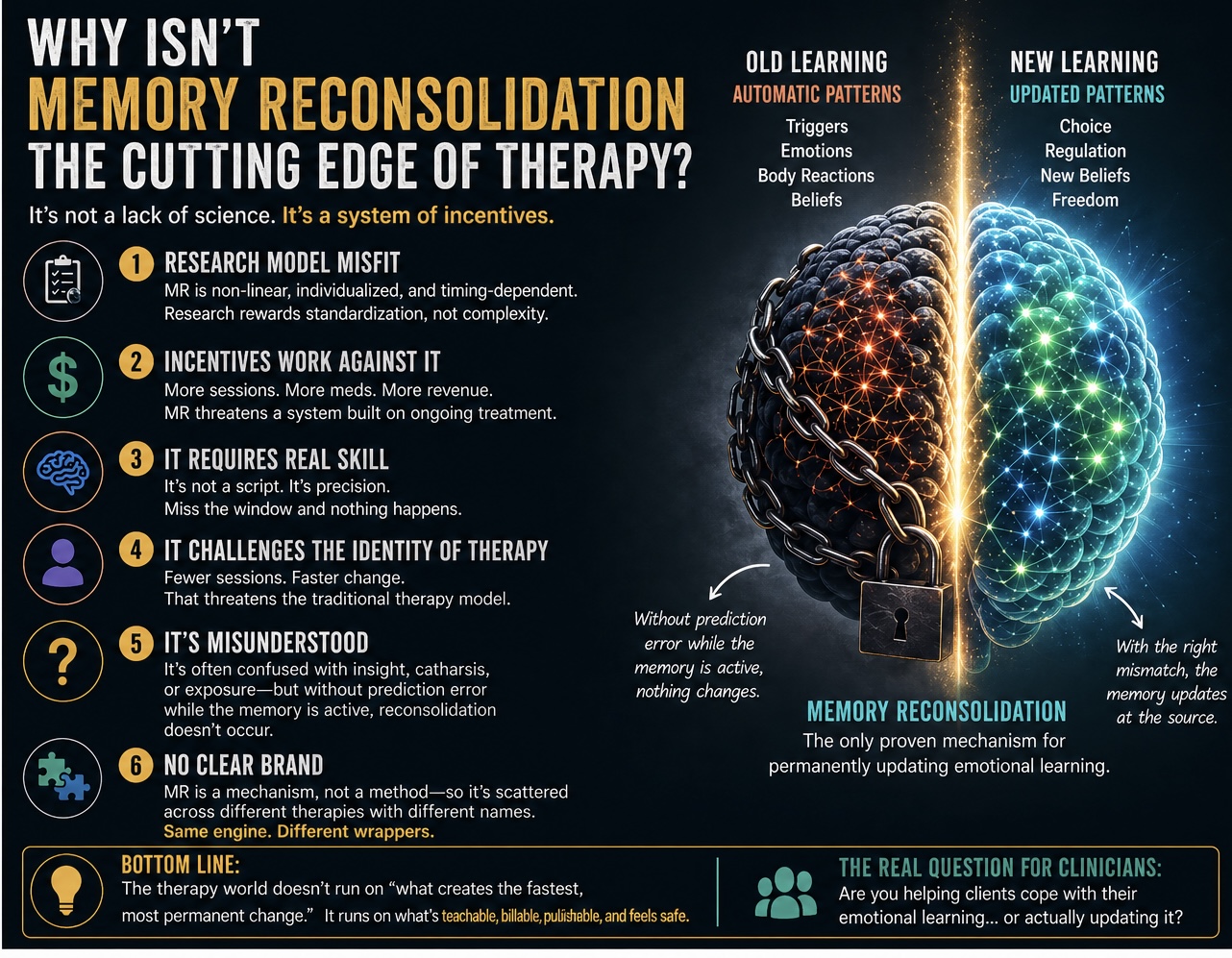
Memory reconsolidation (MR) is the only well-established mechanism we have for permanently updating emotional learning.
Not coping.
Not managing.
Not “insight.”
Actual change.
So why isn’t it dominating the therapy field?
Because the system isn’t built to reward it.
1. It doesn’t fit the research model
MR is:
- non-linear
- individualized
- timing-dependent
Research prefers:
- standardized protocols
- repeatable steps
- symptom tracking over time
That’s why structured approaches dominate. They’re easier to study—not necessarily more effective.
2. The money flows elsewhere
Follow the incentives:
- Medications = ongoing revenue
- Session-based therapy = ongoing billing
- Insurance = pays for time, not outcomes
MR threatens all three:
- fewer sessions
- less reliance on meds
- faster resolution
That’s not what the system is optimized for.
3. It requires real skill
MR isn’t a script.
It requires:
- activating the original emotional learning
- keeping it online
- introducing a real mismatch (prediction error)
Miss the timing → nothing happens.
Or worse → you reinforce the problem.
So most clinicians default to:
- insight
- reframing
- coping tools
Safer. But not transformative.
4. It challenges the identity of therapy
If MR works the way the science says it does:
- You don’t need 50 sessions
- You don’t need years of processing
- You don’t need to “manage” symptoms forever
That’s not just a clinical shift.
That’s a business model problem.
5. It’s misunderstood
A lot of therapists think they’re doing MR when they’re not.
They confuse it with:
- emotional expression
- catharsis
- cognitive insight
- exposure
But without prediction error while the original emotional learning is active, there is no reconsolidation.
6. It has no clear brand
MR isn’t a therapy – it’s a mechanism.
So it shows up scattered across:
- Trauma/Phobia Cure (RTM)
- The Haven Technique
- Dynamic Spin Procedure
- The In Technique
- Eye Movement Integration (EMI)
- FreeSpotting
- BrainSpotting
- Clean Language Therapy (my favorite)
- EMDR
- The Flash Technique
- Coherence Therapy
- Progressive counting
- Rapid Resolution Therapy (RRT)
- (If your favorite isn’t listed – no worries.
Same engine. Different wrappers.
Which means the field misses the common denominator.
Bottom line:
The therapy world doesn’t run on:
“What creates the fastest, most permanent change?”
It runs on:
- what’s teachable
- what’s billable
- what’s publishable
- what feels safe
Until that changes, memory reconsolidation will stay in the background…
Even while quietly being the mechanism behind the therapies that actually work.
If you’re a clinician, here’s the real question:
Are you helping clients cope with their emotional learning…
Or actually updating it?
Clint77090@gmail.com