
Caution!: Only listen to the audios below in a safe place
Shame isn’t who you are – it’s a past-based emotional learning that keeps your nervous system stuck in one moment in time. In this 10-minute self-directed process, using memory reconsolidation, you’ll go to the day before the shame event and observe it from that position, which often triggers a rapid update that dissolves the shame.
There are tens of thousands of books written about shame.
This is a post about how to heal it.
In minutes.
Your belief isn’t required for this to work. Simply follow the steps – there’s no financial cost involved.
This is a 7-minute video overview:
This is an 18 – minute “Deep Dive” into this amazing procedure:
The Core Insight
All emotional states are temporal – they live in the past, present, or future.
If shame is temporal, it is treatable.
And if it’s treatable, it’s no longer permanent.
This 10-minute self-guided process uses your brain’s natural timeline system to help you shift out of shame-without needing to relive the pain.
It’s based on a powerful clinical truth:
Shame isn’t who you are.
It’s where you’re stuck in time.
Let’s help your nervous system move.
⚠️ Before You Begin
This method is safe for self-use only if the shame memory is tolerable to think about.
• If the memory is uncomfortable but manageable → proceed.
• ❌ If it causes panic, flashbacks, dissociation, or shutdown → pause and do this with a skilled practitioner.
That’s not weakness. That’s wise nervous system stewardship.
The 7-Step Timeline Protocol
1. Choose ONE Shame Event
Pick a single, specific moment—not your whole history.
Write down:
• Your age at the time
• Where it happened
• Who was there
• What shame meant to you (e.g., “I’m disgusting,” “I’m bad,” “I don’t belong”)
This anchors the work
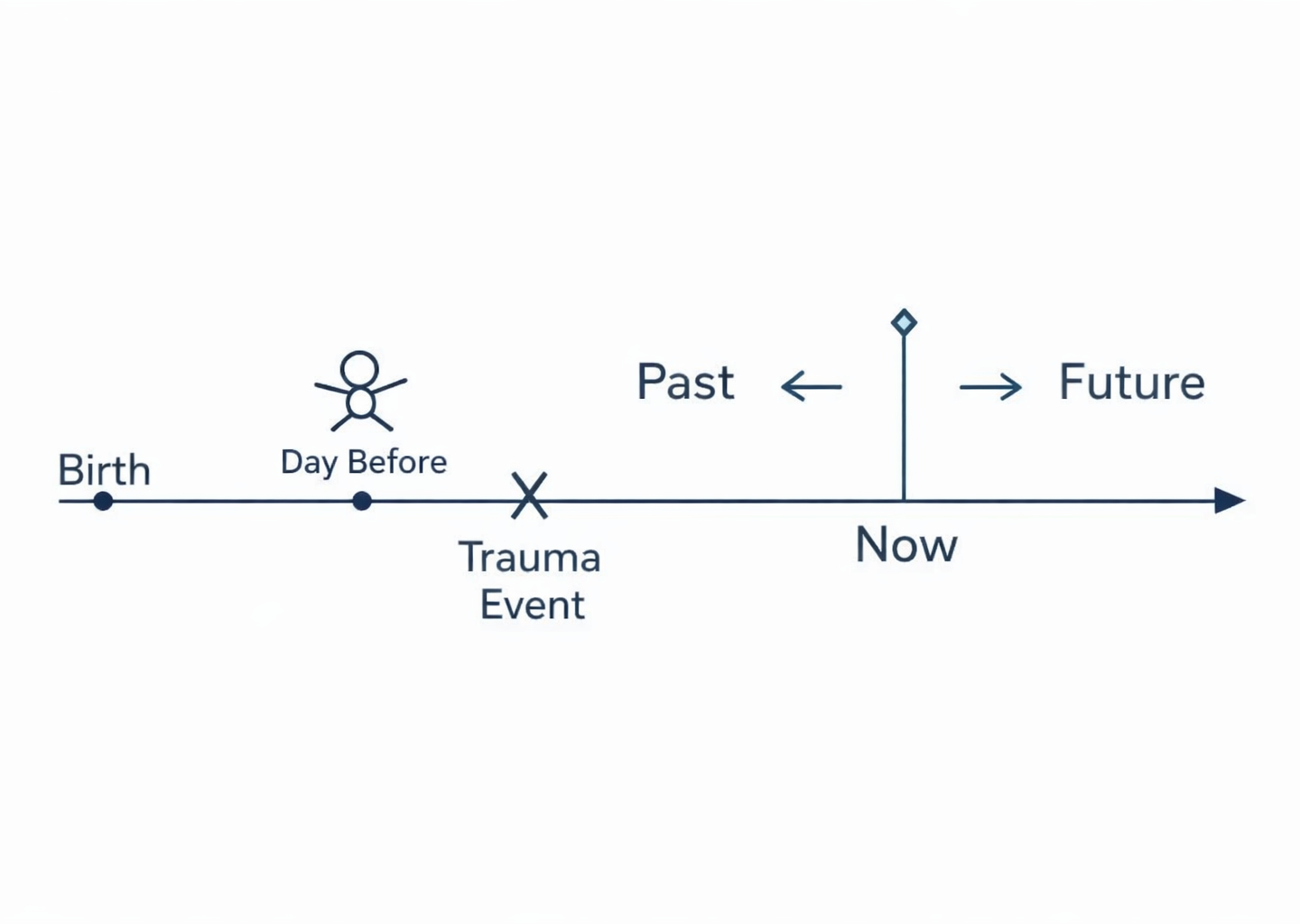
2. Find Your Timeline
Most people describe time as if it has a location:
• “I look forward to seeing you.” (future is in front)
• “Put the past behind you.” (past is behind)
• “I’m stuck back there.” (the past becomes a place)
These aren’t just figures of speech.
They’re clues- your nervous system’s way of mapping time
🎧 Use this 2-minute audio to help you discover your timeline orientation:
If you need more help, this post might help:
https://clintmatheny.com/timelines-how-to-have-a-more-balanced-life/
3. Float Above NOW
Some have requested a guided audio of the process. This is a 3- minute audio of the procedure:
Close your eyes.
Imagine floating above your timeline like a drone.
You can pretend there’s a string tied to your right big toe, anchored to a flagpole labeled “Now.”
Notice:
• Is the future brighter than the past?
• Where is your past? Your future?
You’re not inside the shame.
You’re above it—looking down at your life like a map.
This gives you perspective and control
4. Locate the Shame Event
Still floating, glide back to the moment of shame.
Don’t relive it.
Just find it—like dropping a pin on a map.
No need to feel it. Just notice it.
5. Go to the Day Before
Now float back one more day—to the day before the shame happened.
Turn and look toward the event.
You are now looking at the past… as if it’s in the future.
Say out loud:
“It hasn’t happened yet.”
This creates a prediction error—a mismatch between what your brain expects and what it now perceives

6. Let Your Nervous System Respond
Ask yourself:
“Where is the shame now?”
Then pause. Don’t analyze. Just notice:
• Has it moved?
• Has it shrunk?
• Has it vanished?
• What’s in its place?
Let your body answer
7. Return to NOW and Test
Float back to the present.
Then ask:
• “When I think of that event now, what do I feel?”
• “Where is the shame?”
• “How does my future feel?”
Even subtle shifts matter.
Why This Works
Shame is a past-oriented emotion.
It survives because your brain keeps predicting:
“That event defines me.”
But when you reposition yourself before the event-and look at it as if it hasn’t happened yet—you create:
• Distance
• Prediction error
• Safety
• A new perspective – a new neural pathway that rewires your brain:
https://youtube.com/shorts/SlnfQoSH_LM?si=ECK0Agn_xU2FQ1DQ
These are the ingredients for “memory reconsolidation” – the brain’s natural process for rewriting emotional learnings
Bonus: Repeat as Needed
For many people, the shift happens in minutes. For others, it takes repetition.
You can repeat this process with other shame events—but always one at a time.
If you’re unsure whether a shame is a single event or a chain, ask:
“Was this the first time I felt this kind of shame?”
If yes → great.
If no → start with the earliest one you can remember.
Final Insight
When shame dissolves, something else often shifts too:
Anxiety.
Because anxiety is often built on shame-based predictions:
• “What if they find out?”
• “What if I fail again?”
• “What if I’m exposed?”
When shame collapses, the future becomes less threatening
Bottom Line
Shame is not a character flaw.
It’s not a belief.
It’s not a life sentence.
It’s a memory- stuck in time.
And when you reposition yourself on your timeline…
the shame often stops existing.
Not because you managed it.
But because your brain rewrote it.
If shame is temporal, it is treatable.
If it’s trackable, it’s rewriteable.
If it’s rewriteable, it’s resolvable.
Enjoy life without it.
Feedback welcomed
Also see: https://clintmatheny.com/rtm-1/
Clint77090@gmail.com
Footnotes
Damasio, A. (1999). The Feeling of What Happens: Body and Emotion in the Making of Consciousness. Harcourt.
Ogden, P., Minton, K., & Pain, C. (2006). Trauma and the Body: A Sensorimotor Approach to Psychotherapy. Norton.
, D. (2000). The Transforming Power of Affect: A Model for Accelerated Change. Basic Books.
Lakoff, G., & Johnson, M. (1980). Metaphors We Live By. University of Chicago Press.
James, Tad (1988). Time Line Therapy and the Basis of Personality. Meta Publications.
Ecker, B., Ticic, R., & Hulley, L. (2012). Unlocking the Emotional Brain: Eliminating Symptoms at Their Roots Using Memory Reconsolidation. Routledge.
Porges, S. W. (2011). The Polyvagal Theory: Neurophysiological Foundations of Emotions, Attachment, Communication, and Self-Regulation. Norton.
Lane, R. D., Ryan, L., Nadel, L., & Greenberg, L. (2015). Memory reconsolidation, emotional arousal, and the process of change in psychotherapy: New insights from brain science. Behavioral and Brain Sciences
Gilbert, P. (2009). The Compassionate Mind. New Harbinger.