
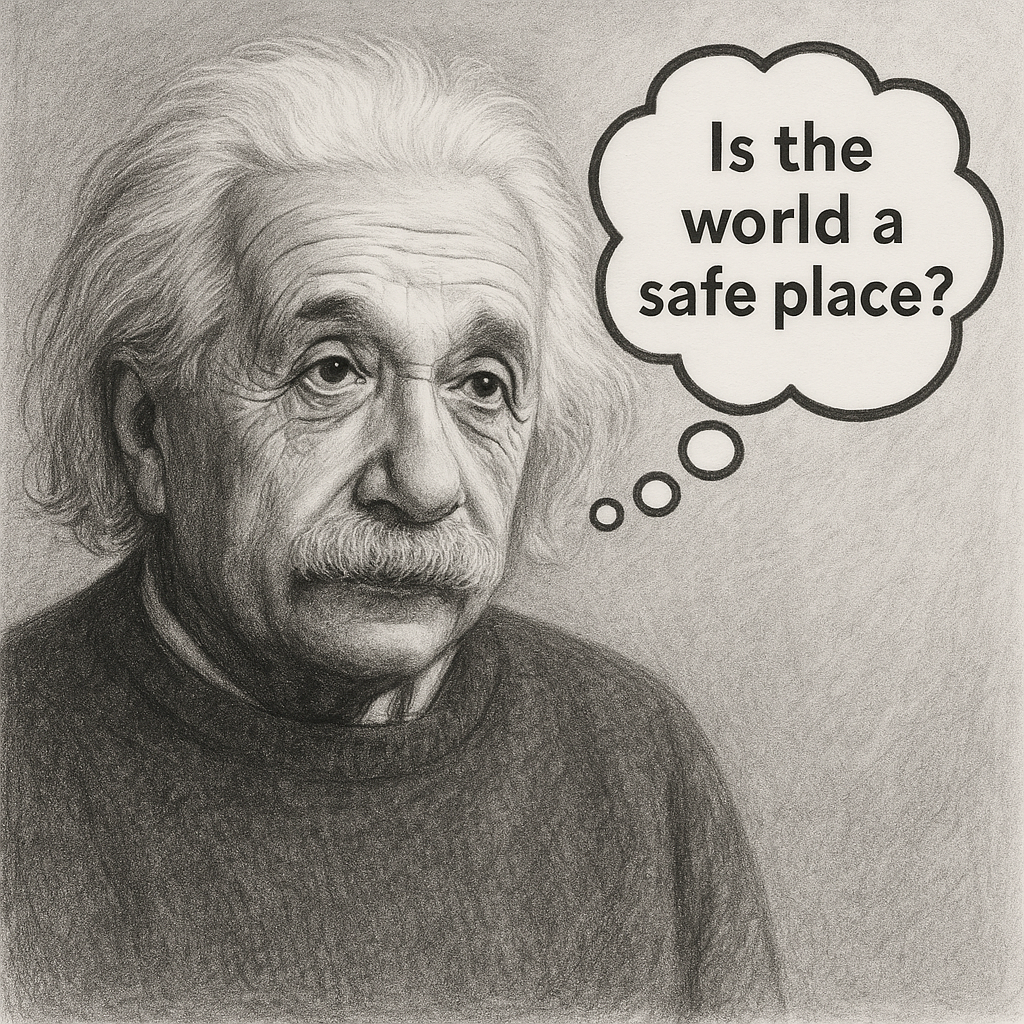
At the beginning of the Cold War and the emerging nuclear arms race between USA and the USSR in the late 1940s, a reporter asked Albert Einstein:
“What question haven’t you been asked that you wish someone would ask?”
He replied:
“Is the world a safe place or a dangerous place?”
When the reporter then asked it, Einstein answered:
“Your answer will make it so.”
This is a 7 – minute overview:
This is an 18- minute “Deep Dive” audio;
He wasn’t talking about physics.
He was describing human perception — and how it shapes reality.
This Question Gets Answered Early
That question – Is the world safe or dangerous? — is not answered intellectually.
It’s answered emotionally, usually in childhood before age 8.
A child’s nervous system is constantly learning:
• Are people predictable?
• Do problems get repaired?
• Is support available?
• Does chaos erupt without warning?
From these experiences, the brain builds a baseline threat setting – a survival model that quietly guides the rest of life.
Most adults think their political beliefs came from reasoning.
In truth, reasoning usually comes later — to justify what the nervous system already concluded.
The Conservative Threat Model
Core survival belief:
“The world is dangerous unless controlled.”
When early experience teaches unpredictability, instability, or lack of protection, the nervous system adapts by prioritizing danger prevention.
This shows up as a pull toward:
• Order
• Structure
• Clear rules
• Boundaries
• Strong defense
• Tradition (“what worked before = safety”)
• Emphasis on personal responsibility
This is not cruelty.
It’s fear management through tightening.
Underneath are emotional drivers like:
• Fear of chaos
• Fear of moral breakdown
• Fear of social instability
• Fear of loss of control
Security first. Freedom second.
The Progressive Threat Model
Core survival belief:
“The world is safe enough to improve.”
When early experience includes enough safety, repair after stress, and emotional support, the nervous system calibrates differently.
It leans toward safety expansion.
This shows up as:
• Inclusion
• Flexibility
• Social support systems
• Rehabilitation over punishment
• Openness to change
• Belief systems can evolve
This isn’t naïveté.
It’s fear management through opening.
Emotional drivers include:
• Empathy
• Hope
• Trust in adaptability
• Lower chronic threat perception
Connection first. Protection second.
What Both Sides Are Actually Doing
Both believe they are:
“Protecting people from danger.”
They just define danger differently.
Conservative Threat Progressive Threat
Disorder Oppression
Weak borders Exclusion
Moral decline Inequality
Cultural instability Systemic harm
Loss of control Social injustice
Both are survival strategies.
• One reduces fear by tightening.
• One reduces fear by opening.
Why the Conflict Feels So Personal
Each nervous system experiences the other as unsafe.
Conservatives often see progressives as:
naïve, reckless, destabilizing.
Progressives often see conservatives as:
cold, rigid, controlling.
Biologically, though, this is not evil vs. good.
It’s two different threat calibrations arguing about how to survive.
These aren’t just policy debates.
They are nervous systems defending their safety model.
Einstein’s Insight in Psychological Terms
Once a person decides the world is dangerous:
• They behave defensively
• They tighten systems
• Others feel restricted
• Conflict rises
• They say, “See? It’s dangerous.”
Loop closed.
Once a person decides the world is safe enough:
• They open systems
• Controls loosen
• Some people exploit it
• Instability appears
• Opponents say, “See? It’s dangerous.”
Loop closed.
Both models create evidence for themselves.
The Mature Position
The world is:
• Dangerous in some places
• Safe in others
• Always changing
A regulated nervous system can hold both truths:
• “Danger exists — but overreaction creates new danger.”
• “Safety can be built — but naïveté creates blind spots.”
This requires flexible threat calibration – the ability to update old emotional learning rather than live from childhood survival maps.
Most political rigidity is not ideological.
It’s frozen threat learning.
The Bottom Line
Political identity is often a nervous system’s long-term answer to:
“How dangerous is the world?”
Until that underlying emotional learning updates, people aren’t really arguing policy.
They’re defending their survival model.
The Hard Historical Truth
Are there “fascist progressive” governments?
Short answer
No.
Based on every major scholarly definition of fascism, fascism is a far‑right, ultranationalist, authoritarian ideology, not a progressive one.
Progressivism and fascism sit on opposite ends of the political spectrum in both values and structure.
Fascism collapses only when the threat model that sustains it is shattered.
In fascist Germany, Italy, and Japan, during WW2, that meant:
- total military defeat
- annihilation of armed capacity
- removal (often death) of leadership
- destruction of symbols, institutions, and narratives (Make ______ Great Again)
That wasn’t persuasion.
That wasn’t moral awakening.
That was systemic interruption.
It could also be called, “Memory Reconsolidation”
Once the survival fantasy was no longer viable – once the ideology could no longer protect anyone – the nervous system had no place left to stand.
Einstein was right & So was FDR
“Your answer makes it so”, because your nervous system will help build the world it expects to see.
“ The only thing we have to fear, is fear itself.” FDR 1933
Written on February 19, 2026
Clint77090@Gmail.Com