

For over 35 years, Imperative Self Analysis (ISA) has been one of my most powerful therapeutic tools:
how-to-break-free-from-your-emotional-autopilot-using-imperative-self-analysis/
This is a 7 – minute video overview into the most life changing therapeutic modality you probably have never heard of:
This is a 18 – minute “Deep Dive Audio”:
In the 1990s, over 400 therapists attended 24 days of training in this modality. It’s a brilliant model. It works.
It helps you map the hidden architecture of emotional suffering – the unconscious internal system that runs a person’s life.
But I’m approaching 81 years of life, and in 2024 I realized something important:
ISA still works – but it can be compressed.
Why I Changed My Approach
Over the years I tried to pass this model on to six therapists. After they successfully collapsed their own Imperative Self maps, something unexpected happened:
They lost motivation to continue doing psychotherapy work and changed occupations.
That may sound strange, but it makes sense. When your own emotional autopilot collapses, your relationship to “helping professions” can change too.
And it led me to a new conclusion:
In many cases, I can help clients change their dysfunctional Imperative Self maps without doing a 2–3 hour ISA elicitation and analysis session.
All I have to do is find:
- their Virtual Question (VQ), or
- their Virtual Statement / Command (VS)
Then do the intervention on the emotional learning that created it.
Because when that cornerstone updates, the rest of the system reorganizes automatically.
What ISA Reveals (And Why It’s So Powerful)
In a full Imperative Self Analysis, you uncover:
- a Filter (what the person automatically notices and deletes)
- a Virtual Question or Virtual Statement (the organizing command)
- a set of Obsessions (“musts” driving behavior)
- an Emotional Menu (the 5–7 recurring emotional states)
For a long time, I believed this full mapping was essential.
But after decades of doing this work, I reached a conclusion 18 months ago that surprised even me:
In many cases, you don’t need a full ISA.
You only need the cornerstone.
The Cornerstone That Runs the Whole System
Leslie Cameron-Bandler (now Leslie Labeau) and her experimental group discovered something decades ago that most therapists still don’t understand:
A person’s entire emotional autopilot can be organized around a single unconscious question or command.
Not a “belief.”
Not a personality trait.
A survival rule.
A Virtual Question often sounds like:
- Am I enough?
- What did I do wrong?
- What do I do next?
- Why can’t I do anything right?
- Will I get this right?
- What’s next?
- What could happen?
- What are people thinking of me?
- Do they like me?
- Am I safe? Is it safe?
- Will I get hurt?
- Why me?
- Will I fail?
- What’s wrong with me?
Notice that many Virtual Questions have a Yes/No structure, and that “answer” determines the emotional output.
Other people don’t run a question — they run a Virtual Statement / Command, such as:
- Don’t screw this up!
- Do it right.
- Stay alert.
- Don’t trust anyone.
- Be perfect.
- Never show weakness.
- Be in control.
- Be strong.
These are not ordinary thoughts.
They are unconscious emotional commands, operating beneath conscious reasoning – and driving everything above them.
What I Realized After Decades of Practice
Here’s what I eventually noticed:
I wasn’t getting results because I did a detailed analysis.
I was getting results because I found the Virtual Question / Virtual Statement, then went back to the origin of the emotional learning and updated it.
And when that happened:
- the obsessions lost urgency
- the filter loosened
- the emotional menu changed
- the whole “personality” shifted
- triggers became neutral
- behavior changed without effort
So I asked myself a hard question:
Why spend all that time mapping every brick in the wall…
…when you can move the cornerstone?
What Trauma Really Is
To understand why this works, you have to understand trauma – not as a diagnosis, but as a mechanism.
Therapy culture often talks about trauma like it’s rare.
It isn’t.
Not everyone meets DSM criteria for PTSD, but most humans carry trauma learning – survival coding written into the nervous system.
Many of these imprints form in childhood, often between ages 3 – 7, when the nervous system is building its earliest emotional rules. To an adult they may sometimes seem silly, but to a 3-7 year old – horrifying!
Other trauma imprints form later in life after major events:
- accidents
- war
- sexual abuse
- torture
- disasters
- sudden loss
In both cases, the nervous system learns a rule.
And that rule becomes the VQ or VS.
PTSD: The Filmstrip Loop
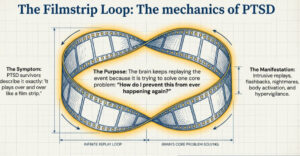
If you ask adult PTSD survivors what it feels like, many will tell you:
“It plays over and over like a film strip.”
That is not exaggeration.
That is exactly what PTSD can feel like:
- intrusive replay
- flashbacks
- nightmares
- body activation
- hypervigilance
- shutdown
- numbness
And most people misunderstand it.
PTSD is not the person “thinking about the past.”
PTSD is the nervous system running a loop.
The brain keeps replaying the event because it’s trying to solve one core problem:
How do I prevent this from ever happening again?
That’s the Virtual Question.
The Real Insight: PTSD Is a Virtual Question Stuck on Repeat
When you strip away clinical labels, PTSD is often built around a few core questions:
- Am I safe?
- Is it happening again?
- What did I miss?
- How do I stop it?
- How do I escape?
- Who can I trust?
That’s why the person can’t stop thinking about it.
They’re not choosing to obsess.
Their nervous system is trying to update a survival map — and it can’t.
So it repeats.
Until the emotional learning changes, the loop continues.
Why Most Therapy Misses This
Most therapy still treats trauma like it’s a story.
So the client talks.
They process.
They explain.
They gain insight.
They understand.
But the nervous system doesn’t change.
Because insight alone usually does not rewrite survival encoding.
That’s why so many people say:
“I understand why I’m this way… but I still feel the same.”
Exactly.
Understanding doesn’t update emotional learning.
What Actually Changes People (And Why It Can Be Fast)
Modern neuroscience now has a name for what effective therapy has been doing all along:
Memory Reconsolidation
Memory reconsolidation is the brain’s mechanism for permanently updating emotional learning.
When the original learning is activated — and then contradicted by a corrective, incompatible experience — the old rule becomes editable.
That’s the mechanism.
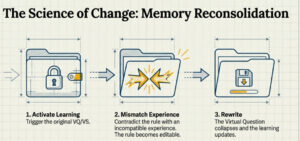
And when the emotional learning changes, the Virtual Question collapses.
Not answered.
Collapsed.
What Happens When the VQ/VS Collapses
When reconsolidation occurs, people often report:
- the obsessional track goes quiet
- triggers become boring
- identity shifts feel neutral
- the emotional menu changes
- the “personality problem” dissolves
- behavior changes without effort
- no maintenance is required
That’s not coping.
That’s not management.
That’s a system reset.
My Conclusion After 35+ Years
ISA is a brilliant model.
It reveals the architecture of suffering with incredible precision.
But I no longer believe it’s always necessary to map the entire system.
Because the true leverage point is the cornerstone:
The Virtual Question / Virtual Statement is the doorway into the whole Imperative Self.
So if you can find it quickly and cleanly…
You can do the intervention directly on the part that created the VQ or VS using current therapy modalities that use Memory Reconsolidation !
And once the emotional learning reconsolidates, the entire system reorganizes.
Final Thought
If you’ve lived inside the same emotional loops for years..
Don’t assume it’s your personality.
It may be one unconscious question you’ve been trying to answer since childhood.
And here’s the best news:
If the rule was learned,
it can be unlearned.
PTSD isn’t the past.
It’s the nervous system stuck in the past – still repeating the same question or command.
And when that question or command collapses, life opens up.
See: using-imperative-self-analysis/
Clint77090@gmail.com